
In recent months, the news reported measles outbreaks in Israel and around the world. In Israel, from 40 cases in all of 2017, the numbers are up to 700 in October alone, over 1,400 by middle of November this year. Here are answers to some questions you might have, traveling to or staying in Israel.
Am I at risk? Who can be infected with the measles?
Measles vaccination is reliable – it works – and most of us are vaccinated, or have been exposed in our childhood. If you are planning to travel to Israel, you should check that you have been immunized, most importantly you should make sure your children are immunized.
The vaccine is only administered from 12 months, and it needs a second shot (the standard schedule spaces doses years apart, but in an outbreak or travel situation a minimum of 4 weeks between doses is acceptable — check current Israeli Ministry of Health guidance) to develop maximum immunization. Thus infants and babies under the year of 1 are at risk, as well as immunosuppressed patients.
I was vaccinated as a child, am I still at risk?
Although there is no 100% guaranteed protection, studies show only 4 out of 100 vaccinated individuals will contract the disease upon exposure.
The vast majority of reported measles cases now in Israel are patients that have not (yet) been vaccinated, mostly children. The majority of cases thus are reported in communities where vaccination coverage is lower than average, such as some haredi communities around Jerusalem.
How can I catch the measles?
Measles is highly contagious, and the infection happens airborne. The fact that patients are contagious from about 4 days before the rash appears until 4 days after it appears (around 8 days in total) makes vaccination practically the only way to reliably fight the outbreak.
What are the signs and symptoms of measles? When to suspect an infection?
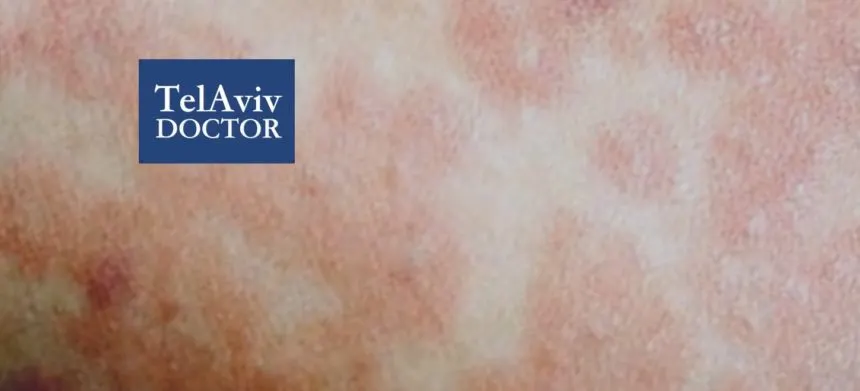
The first signs of an infection will be common high fever, a runny nose and coughing, red eyes and sensitivity to light. Only a few days later, very typical spots develop in the mouth, and only four or five days after the disease started, the typical red skin rash will appear. Usually the rash will spread from the face and hairline, down the neck and body.
I was exposed to measles, what should I do?
If you know for sure you have been exposed to measles, you should contact a doctor and you might receive a so called ‘active vaccine’ that will help your immune system activate antibodies. The MMR vaccine works best as post-exposure protection if given within 72 hours of exposure. If you are immunocompromised, MMR is not suitable — ask specifically about immune globulin (IG), which can be given within 6 days of exposure instead.
How dangerous is a measles infection?
Measles is highly infectious, there is no remedy, but it is also important to understand that measles is generally a mild self-resolving disease that passes after a week or two.
There is a risk for serious complications such as pneumonia (in about 1 in 20 children) and encephalitis (swelling of the brain, in about 1 in 1,000 cases), so be sure to get in touch with a doctor to monitor the course of the disease and to have the symptoms treated. And remember: it is a highly infectious disease, you will help everyone by staying at home.
What is Israel doing about the measles outbreak?
The Israeli Health Ministry has started a campaign to increase vaccination coverage in communities most affected by the outbreak. The ‘Tipat Chalav’ nursing centers are currently overloaded and working extra shifts to vaccinate as many children and individuals possible.
Can I do anything about it now ..?
Most importantly: check that your children have been vaccinated. The vaccine is given in two doses, one at age of 12 months and the second dose at least 6 months later (in Israel at the age of 6 years). In some cases you can receive a first vaccine shot already at 6 months of age (which does not replace the shot at 12 months of age).
If your children are vaccinated, and you are not at special risk, there is currently nothing to do – and most likely nothing to worry about.
If you think that you or your child has measles, please call us (at +972 (0)54-941-4243) or email us ([email protected]) and we will advise.